Tuesday, 26 June 2018

How to Help a Friend Through a Dying Marriage

Christians should be ready to care for those in the aftermath of divorce without making their pain worse.

I walked a dear friend through the grief of a dying marriage last year. After less than two years enjoying what she thought was a wonderful marriage, she discovered the lies and the multiple infidelities her husband had been covering up since before they were married. Even worse, he was unrepentant for his numerous betrayals.

It was the first and only time I ever counseled anyone to seek a divorce.

We both knew how deeply marriage matters to God and that covenantal relationships are not intended to be broken. Yet, God gives his people clear guidelines for times when divorce might be the only acceptable solution. In her case, the damage and lies were too numerous to overcome with only one party committed to repairing their failed relationship.

As her marriage died, I was able to come alongside her, mourning her husband’s unrepentant heart and the future that she had lost. I saw the heartbreak the revelations of her husband’s deceit brought. Then her outlook sunk lower when she recognized that they weren’t going to be able to work to mend their young marriage, and this was the end.

These seemed like inevitable aspects of the pain of divorce. What I didn’t anticipate was her agony grow as she walked into church on Sunday morning.

As a church, we are significantly more committed to staying married than the culture around us. Unfortunately, sometimes the biblical zeal for marriage overwhelms the need for grace, support, and care for those who are victims of the broken relationships bound to arise in our sinful world.

So in her Christian community, the gossip spread. She quietly backed away from her former church, in hopes that her husband would be free to experience repentance and heal in the midst of a community ...

Continue reading...


from
http://feeds.christianitytoday.com/~r/christianitytoday/ctmag/~3/k-JbMwdYXZo/divorce-church-how-to-help-friend-through-dying-marriage.html


One-on-One with Nick Hall on Faith in the Next Generation, Part 1

God has been stirring and the church has been uniting.

Ed: Nick, tell me a little bit about what you’ve been doing lately.

Nick Hall: For the last several years, we’ve been in the middle of a city-wide movement in the Twin Cities. Churches and leaders have been coming together across the Twin Cities. We've been meeting in prayer and worship and building friendships, wanting to reach our community with the gospel. This unification has been a baseline for some amazing things. We’ve had some reconciliation, discussions and understanding on race and justice, and then we’ve been talking about church planting and immigrant populations.

We just hosted a massive outreach expression that we've been building up to for the last 18 months. We believe it's a continued sign of what God is doing across the country. We had 750 churches come together, 1,800 pastors unite, over 10,000 believers praying and linking arms together through different gatherings – all united around the effort to reach the next generation. About 9,000 believers went through training to share their faith and disciple their friends. All of this built up to an outreach event where we filled the U.S. Bank Stadium – the stadium where the Super Bowl was just held.

It was the first stadium event here since Billy Graham came in 1996 on a crusade, which was directed by Jeff Anderson. His son, Jay Anderson, was one of the directors of the event we just hosted. We booked the stadium as an act of faith and planned this enormous next generation-focused outreach event for May 18th. We ended up having 50,000 people in attendance and over 9,000 young people responded to the gospel.

We’ve had an incredible follow-up effort partnering with hundreds of churches. Churches have been launching ...

Continue reading...


from
http://feeds.christianitytoday.com/~r/christianitytoday/ctmag/~3/PafB1wugMRo/one-on-one-with-nick-hall-on-faith-in-next-generation-part-.html

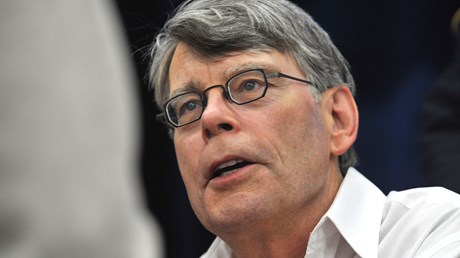
Stephen King Wrestles with the Divine

The horror writer is no fan of organized religion, but his stories don’t shy away from belief in things unseen.

Say what you will about Stephen King, but the man has staying power. Last year’s Dark Tower may have flopped, but the big screen adaptation of It raked in oodles of cash (part two is currently in pre-production). And this summer witnesses Sissy Spacek’s long-awaited return to the Maine hinterlands of King’s Castle Rock, her first time collaborating with the author since her career-defining role as Carrie in 1976. King himself shows no sign of slowing down, with an epic new novel on stands this summer, The Outsider, and another on the horizon.

With each passing year, the horror master’s shadow only grows longer. The Duffer Brothers, creators of Stranger Things, went so far as to pay tribute to their hero with the logo of their hit Netflix show. Meanwhile, King’s own sons, Joe Hill and Owen King, are both novelists in the same vein as their dad, each boasting significant followings of their own. (His daughter, Naomi, is a Unitarian minister.) Even critics have begun acknowledging the man’s dazzling versatility.

King’s profile has been so high for so long that it’s a bit surprising that Douglas Cowan’s America’s Dark Theologian marks the first full-length treatment of the religious themes in his work. “Constant readers,” as King aficionados are known, are already well aware that he doesn’t shy away from the subject.

While it’s true that organized religion seldom comes off well in his books, King handles the Christian faith itself in a myriad of ways—as the motivator for bravery just as often as cruelty, a reservoir of strength as well as a shield for cowardice. Characters regularly wrestle with the divine, and rarely the same way twice. Sometimes ...

Continue reading...


from
http://feeds.christianitytoday.com/~r/christianitytoday/ctmag/~3/MHfprHC2Vag/stephen-king-douglas-cowan-americas-dark-theologian.html

Monday, 25 June 2018

Dinosaurs 1, Humanity 0

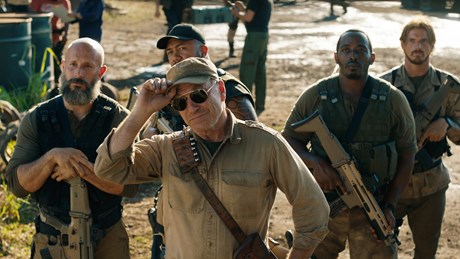
Why do films like ‘Jurassic World: Fallen Kingdom’ urge us to rejoice in the death of the wicked?

“Nasty woman!” hunter Ken Wheatley (Ted Levine) says of Claire Dearing (Bryce Dallas Howard) after she says something defiant to him from her makeshift prison cell in the back of his truck.

Wheatley has already shot a man with tranquilizers and left him for dead on an island with an active volcano and wild, roaming predators. He has threatened to murder a medical biologist if she doesn’t save a valuable specimen that has been shot. He is part of a business scheme that will threaten countless lives—the entire world, really—one he enters into with relish simply for the reward of money. (Wheatley’s most often repeated line is, “I want my bonus!”) He’s also a sadist, pulling teeth from sedated animals for a makeshift necklace while chuckling about how much pain they will feel when their anesthesia wears off.

The purpose of such relentlessly underlined psychopathy is no mystery to anyone who has sat through a summer action movie in the last 20 years. He’s being marked for execution, and the movie wants us to know it is okay to cheer when he finally gets what’s coming. And it works. The audience with whom I saw Jurassic World: Fallen Kingdom chuckled gleefully as Wheatley entered the cage of a particularly vicious dinosaur genetically altered to be larger and more aggressive than its ancestors of past movies. When it wakes up, as we knew it would, and bites his arm off, as we knew it would, the camera lingers on his agonizing final moments.

This is nothing new. To a large extent, the summer action movie’s reason for being is to satisfy our bloodlust. The first film I reviewed for my college newspaper, James Cameron’s Aliens, features an evil corporate villain ...

Continue reading...


from
http://feeds.christianitytoday.com/~r/christianitytoday/ctmag/~3/Dn5fP3hgpSA/jurassic-park-fallen-kingdom-villain.html

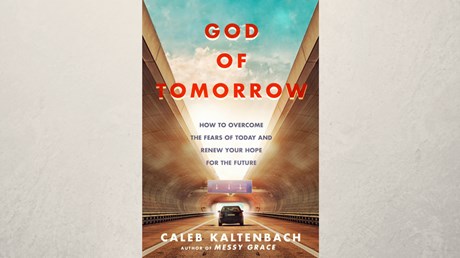
One-on-One with Caleb Kaltenbach on ‘God of Tomorrow: How to Overcome the Fears of Today and Renew Your Hope for the Future’

Our current and future circumstances don’t negate God’s power, plan, or promises.

Ed: A lot of believers feel like everything is changing, often for the worst. Why do you think there is so much fear?

Caleb: We’re usually afraid of circumstances and people that we don’t understand or cause us feel out of control. Fear launches us into uncertainty and forces the acknowledgement of our limits as humans. For instance, despite our valiant efforts to reverse societal trends, many of us may not know why the ethics and moral compass of our society are drifting away from Judeo-Christian values.

Reacting with fear allows us to stabilize our fearful emotions in sinful ways. People pleasing, bashing society, throwing out truth, micromanaging, legalism, and isolating ourselves from others are just a few of our destructive solutions that hurts others and brings more fear. Loving God and focusing on him is a much better response.

Ed: You emphasize in your book God of Tomorrow that although our society is rapidly changing, God never changes. What are the implications for our faith of an unchanging God in this frenetic world?

Caleb: Society’s trends, people’s opinions, and the severity of injustices are always changing. However, our current and future circumstances don’t negate God’s power, plan, or promises. Revelation 20-22 promises God’s justice and fulfillment of his redemptive plan.

Unlike everything else in life, God never changes and is completely trustworthy. If he is good, unchanging, and has our back, then we can trust him, love others, and be courageous. Cultural tragedy and everyday life will punch us in the gut again, but our expectant hope is that our unchanging God will guide us and work all things out to His glory. Such hope transcends today’s trials and points ...

Continue reading...


from
http://feeds.christianitytoday.com/~r/christianitytoday/ctmag/~3/wNpPWWDFm4o/one-on-one-with-caleb-kaltenbach-on-god-of-tomorrow.html

Saturday, 23 June 2018

here's your title

you need to create deck

Video update from Alexander on L-Canada (5 min)

Nick Hall talk about MAC (5 min)

Karen talks about what L-NA groups look like (use Correctional as example) (3 min)

Joy Tira talks about formation of diaspora group and what to expect (3 min)

Sam Chiang talks about formation of orality/bible literacy group and what to expect (3 min)

Power of partnership by Cody Lorance and Erin Kawaye (5 min)

Ed transitions to the State of the Gospel in North America and gives presentation (15 min)

Where do we go from here? Show OGS Movement video (2 min)

Ed talks about OGS Movement and invites everyone to get on-board (8 min)

World Relief video and presentation (8 min)

Ed closes, invites people to connect with L-NA (5 min)

Ed Stetzer holds the Billy Graham Distinguished Chair of Church, Mission, and Evangelism at Wheaton College, serves as Dean of the School of Mission, Ministry, and Leadership at Wheaton College, is executive director of the Billy Graham Center, and publishes church leadership resources through Mission Group.

Continue reading...


from
http://feeds.christianitytoday.com/~r/christianitytoday/ctmag/~3/W4ttVeF2U4M/heres-your-title.html

Friday, 22 June 2018

Does Your Church Have Enough Samaritans?

Samaria has always been as fruitful a venue for the gospel as it has been a repulsive place for God’s people to initially consider engaging.

Jesus’ final words on earth are in Acts 1:8: “You will receive power when the Holy Spirit comes on you; and you will be my witnesses in Jerusalem, and in all Judea and Samaria, and to the ends of the earth.”

I think most churches do reasonably well in equipping members to reach their Jerusalem – those in close proximity like neighbors, co-workers, fellow soccer parents. And in Judea – people residing in other parts of the country or world, but who are mostly like us – relatives, fellow employees in other locations, or the guy in the seat next to you on a plane.

And we engage lots around the ends of the earth these days, as record numbers of us head off to Haiti, Guatemala, or Africa on short-term mission trips.

But when is the last time you were challenged to reach into Samaria? Oh, and by the way, where is Samaria, again?

Where is Samaria, Anyway?

For Jews living in Jesus’ day, Samaria represented those half-breed ‘dogs’ to the North who were in love with their pagan idols. stories like The Good Samaritan that might have a nostalgic ring to our ears came off to first-century Jews as a contradiction of terms at best, and repulsive at worst. Perhaps synonymous to: The Good Criminal.

For most of us, the terms good and criminal do not belong together. So, now we’re getting the point.

Samaritans represent the outcasts—the people we are most repulsed by and want nothing to do with. For Jonah, it was the Ninevites, not because he was afraid of them, but because he was afraid God would forgive and bless the scumbags (Jonah 3:10-4:2)! And even though we have lots of precedence for God using those who’ve broken the law in some pretty heinous ways—i.e., Moses, ...

Continue reading...


from
http://feeds.christianitytoday.com/~r/christianitytoday/ctmag/~3/iuUhw37roEY/does-your-church-have-enough-samaritans.html